
How to Create Contact and Account Records from a Business Card: A Practical Guide
In today’s fast-moving business environment, networking still plays a powerful role in building relationships and generating opportunities. Whether it’s a conference, trade show, or a casual meeting, business cards remain a simple yet effective way to exchange information. However, the real value of a business card is not in the paper itself—it lies in how efficiently you Generate Lead from Business Card and Generate Contact from Business Card through accurate business card to contact conversion and structured CRM data.
With the ability to Scan business card to create contact, businesses can instantly capture and organize valuable contact information without manual data entry. You can also Scan business card into CRM to ensure every new connection is automatically stored, enriched, and ready for follow-up. For sales teams, the ability to Scan business card into Salesforce helps streamline lead management, improve data accuracy, and accelerate the sales process.
Using a card scanner app simplifies this entire workflow by capturing contact details accurately and reducing manual data entry. Many professionals also rely on a digital business card app to create, share, and manage contacts seamlessly, while an electronic business card offers a modern, paperless way to exchange professional information and keep contact details up to date.
With modern tools like a business card scanner CRM, business card scanning app, or digital business card scanner, it has become much easier to scan business card to contacts, create contact from business card, and even save business card to phone contacts instantly. These tools also support business card data entry automation, helping sales teams reduce manual work and improve accuracy.
This article explains how to properly convert business card to CRM records and manage them efficiently.
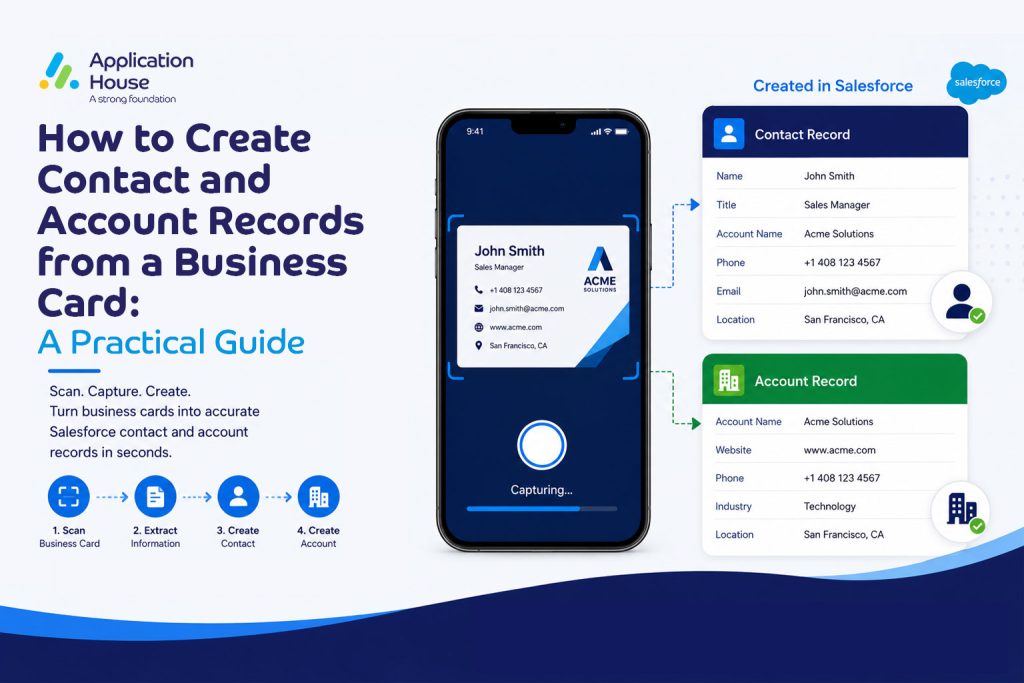
Why Business Card Scanner App Matters to Scan Business Card to Contacts
A business card typically contains essential details like name, job title, company, email, and phone number. If this data is not properly captured, it can lead to lost opportunities and poor follow-ups. With the ability to Scan business card to create lead and Create CRM lead from business card, you can instantly convert business card details into organized CRM records. Using a business card reader app or CRM system ensures that every interaction is recorded and organized. Proper conversion helps avoid:
- Lost leads and missed follow-ups
- Duplicate or messy CRM records
- Manual data entry errors
- Inefficient sales tracking
By using automated tools for business card to contact conversion, businesses can improve productivity and maintain clean customer data.
Step 1: Capture Data Using a Business Card Scanner
The first step is to capture information from the card. Traditionally, this was done manually, but now a business card scanning app or business card scanner CRM makes the process much faster.
These tools allow you to:
- Scan cards using your phone camera
- Automatically extract text using OCR technology
- Instantly save business card to phone contacts or CRM
Key details to capture include:
- Full Name
- Job Title
- Company Name
- Email Address
- Phone Number
- Website and Address
A digital business card scanner improves accuracy, but it is always recommended to verify the extracted information.
Step 2: Create or Identify the Account Record
In CRM systems, an account represents the company associated with the contact. Before you create contact from business card, always check if the company already exists.
For example, if the card belongs to someone from Application House, search the CRM first.
If the Account Exists:
- Open the existing Application House account
- Review linked contacts
- Add the new contact under the same account
If the Account Does Not Exist:
• Create a new account named Application House
• Enter company details consistently
• Add industry and other available information
This ensures proper organization when you convert business card to CRM records.
Step 3: Create the Contact Record
After identifying the account, the next step is to create contact from business card.
Enter the following details carefully:
- First Name and Last Name
- Job Title
- Email Address
- Phone Number
- Linked Account (e.g., Application House)
A good CRM system supports business card data entry automation, reducing manual typing and improving speed. This is especially useful for sales teams handling large volumes of cards.
Step 4: Add Context and Notes
A business card alone doesn’t tell the full story. Adding context helps build stronger relationships.
Include details such as:
- Where you met the person
- Purpose of conversation
- Interest in products or services
- Follow-up actions discussed
Step 5: Tag and Categorize Contacts
Tags help organize data for future use. When using a business card reader app, you can quickly assign categories.
Common tags include:
- Industry: IT, Manufacturing, Services
- Lead Type: Hot, Warm, Cold
- Source: Event, Referral, Website
For Application House, you might use:
- Industry: Technology
- Lead Source: Conference Networking
This improves searchability after you convert business card to CRM.
Step 6: Schedule Follow-Ups Immediately
The biggest mistake in business card handling is delaying follow-ups. After using a scanner for card or a business card application, follow up quickly, whether the contact came from business card printing or a digital card.
Follow-up actions may include:
- Sending an introduction email
- Sharing product information
- Scheduling a meeting or demo
- Connecting on LinkedIn
Fast action increases conversion rates significantly.
Benefits of Business Card Data Entry Automation
Modern business card data entry automation tools offer several advantages:
• Faster lead capture
• Reduced manual errors
• Real-time CRM updates
• Better sales productivity
• Improved lead tracking
By using automation, companies can scale their networking efforts without increasing workload.
Best Practices for Better Results
To maximize efficiency when handling business cards:
• Always use a digital business card scanner for accuracy
• Avoid duplicate account creation
• Standardize company naming like Application House
• Regularly clean CRM data
• Train teams on proper scanning and entry processes
Common Mistakes to Avoid
Even with automation tools, errors can happen:
• Incorrect spelling during scanning
• Not linking contacts to accounts
• Ignoring duplicate records
• Missing follow-up tasks
• Poor data validation after scanning
Avoiding these ensures your CRM stays clean and useful.
Conclusion
Efficient business card to contact conversion is essential for modern sales and networking success. With tools like a business card scanner CRM, business card scanning app, and business card reader app, businesses can easily scan business card to contacts, create contact from business card, and convert business card to CRM systems with minimal effort.
When combined with business card data entry automation, the entire process becomes faster, smarter, and more reliable. Ultimately, turning a simple card into structured CRM data—such as for companies like Application House—helps businesses build stronger relationships and close more opportunities.